Personal
self-serve — free to start; paid plans open every feature for 7 days at the plan's usage caps, then bill — cancel anytime
Sophia is a Kru.
Sophia is a Kru — the front office your business never got around to hiring.
Sophia holds the posts your front office never filled: Front Desk, Phones, Inbox, Invoices and Reviews. For a person, she is your Ace. Both are found on the Square.
Nothing gets dropped.
You stay in charge.
Personal
self-serve — free to start; paid plans open every feature for 7 days at the plan's usage caps, then bill — cancel anytime
Business
every company engagement starts on a 15-minute call — no card, no commitment
The Sophia Network
free to join — Sophia sits in the middle of every match; nothing is agreed without you
01 · Three doors, one Sophia
A person, a company, a trade. What changes is the house rules and who is on the other end, not Sophia. The same four kinds of work run under all three.
A person whose name arrives somewhere before they do.
Sophia is your Ace.
Your Ace: how you are represented, who gets through, and what she answers for you.
Businesses whose calls and messages arrive faster than anyone can pick up.
Sophia is a Kru.
A Kru on your front office: customers, prospects, your leaders' inbound, other companies' agents. All held under your house rules.
Businesses that want the right requests reaching them, and the rest answered without a call.
The Sophia Network is the Square.
The Sophia Network is the Square: where Krus and Aces are found. Every door has Sophia at it, and asks meet offers. She answers by the owner's rules and hands the real ones through, Sophia to Sophia.
One Sophia, three doors
A person whose name arrives somewhere before they do.
Businesses whose calls and messages arrive faster than anyone can pick up.
Businesses that want the right requests reaching them, and the rest answered without a call.
Every approach answered, whatever channel it came in on.
Inbound runs on the Personal line.Customers, on every channel, answered on arrival.
Inbound runs on the Business line.The job taken down conversationally, then qualified.
Inbound runs on the The Sophia Network line.The personal line does no selling and no lead generation.
Sales Support does not run on the Personal line.The follow-through around your reps.
Sales Support runs on the Business line.Qualified demand, matched by hand to the pro who wants it.
Sales Support runs on the The Sophia Network line.The gate: screened against a bar you wrote yourself.
Executive Support runs on the Personal line.Your Ace in front of a leader's inbound.
Executive Support runs on the Business line.No leader's gate in a marketplace.
Executive Support does not run on the The Sophia Network line.A door another company's agent can address you through.
Agent-to-Agent runs on the Personal line.An authenticated door for machine approaches.
Agent-to-Agent runs on the Business line.Not built for this line.
Agent-to-Agent does not run on the The Sophia Network line.The blanks are boundaries, not a roadmap. The personal line does no selling because that is a rule the product enforces, and a marketplace has no leader’s gate to run. Neither is a feature waiting to arrive.
Read across a row and one capability is running on every line that has it — the same rules engine, the same four outcomes, the same human as the hard stop. Read down a column and you have what a single line gets. It is one Sophia either way.
02 · The four kinds of work
Customers, prospects, a leader’s own inbound, and other companies’ agents. Four ways the outside world reaches you. One Kru holds all four; you never buy them as four tools.
One category, four sides
Customers
Front Office
Prospects
Sales Support
An executive’s inbound
Executive Support
Other companies’ agents
Agent-to-Agent
all arrive at the same post
Answered where it arrived, decided against your house rules.
and every item resolves
Outcome
Handled in your voice
Outcome
Held, with what is missing named
Outcome
Escalated to a named person
There is no fourth state. Nothing sits in a queue waiting for someone to have capacity for it.
The four lines are not four products. They are the four ways the outside world reaches a business, which is why one Kru holds all four.
Customers
Every call, text, email and form answered the moment it lands, screened against your house rules, and booked. Nothing sits in a queue.
Businesses whose calls and messages arrive faster than anyone can pick up.
Prospects
The follow-through around your reps — pipeline kept current, quotes and invoices raised, and follow-up that actually happens.
Sales teams losing more to unworked follow-up than to lost deals.
The executive's own inbound
Your Ace in front of a leader's inbound: every approach screened against the bar they wrote, and only what earns it reaches them.
Leaders whose inbound has outgrown the person managing it.
Other companies' agents
An authenticated endpoint where another company's agent can put a structured proposal to yours and get a bounded, grounded decision back.
Companies already receiving machine-generated approaches.
03 · The difference
This is the whole product. Sophia does not just reply. She decides against your house rules, and every decision is written down with the rule behind it. Worked example
Any channel — call, text, email, web form, social. Answered the moment it lands, not the next business morning.
The intake criteria your team wrote, applied the same way every time. Where nothing is written, the default is to protect rather than guess.
Real but incomplete does not become a fabricated answer. It is held, with a draft asking for exactly what is missing.
Nothing commits you. Approve it, edit it, or take the conversation yourself — and the rule that held it is on the record.
Web form · 11:41 pm
“We’re looking at replacing our current provider across all our sites before the end of the quarter. Who should we be talking to?”
Sophia · screening
Checked against your intake rules.
Multi-site inquiries route to the enterprise team — never to general sales. Site count is required before routing.
Qualifies · one detail missing
Sophia · draft reply
“Thanks for reaching out — this sounds like one for our enterprise team rather than general sales. So I put you with the right person first time: how many sites are in scope?”
Your enterprise lead · 8:02 am
Approved. Sent, and the thread is mine.
Held overnight · routed, not lost
A day, from the inbound’s point of view Worked example
24hours answered
Every hour on the dial. An inbound that lands at midnight is answered at midnight, in your company’s voice.
The rest of the dial is the part most businesses answer the next working morning. That is where the queue comes from.
Answering out of hours is not the same as committing you out of hours. What needs judgment is held with a draft until someone is there to approve it.
The dial says only that a day has twenty-four hours and a staffed front desk does not cover all of them. Nothing here states how much of your inbound arrives out of hours, because that is yours to know and we have not measured it.
04 · Hired, not installed
Your team already runs more systems than it has hands for. It does not need another one. What matters is not what software can do. It is who holds the post.
You are not buying software. You are putting a Kru on the posts.
Every tool you were ever sold came with the work attached. This one comes with the work done. The house rules are yours. The posts are hers. The difference shows up in whose day the work lands on.
Your house rules are written with you on a call. Nothing goes live before they exist. Nobody on your side learns a screen to get the value.
JOOLT keeps every way in, every hand-off and every rule change. Your team decides the policy. Nobody runs a tool.
Every outcome is written down with the rule that produced it. You can read it and correct it. Nothing is taken on faith.
05 · See it
This is the public door an approach meets before it reaches a represented person. Real product, not a mockup.
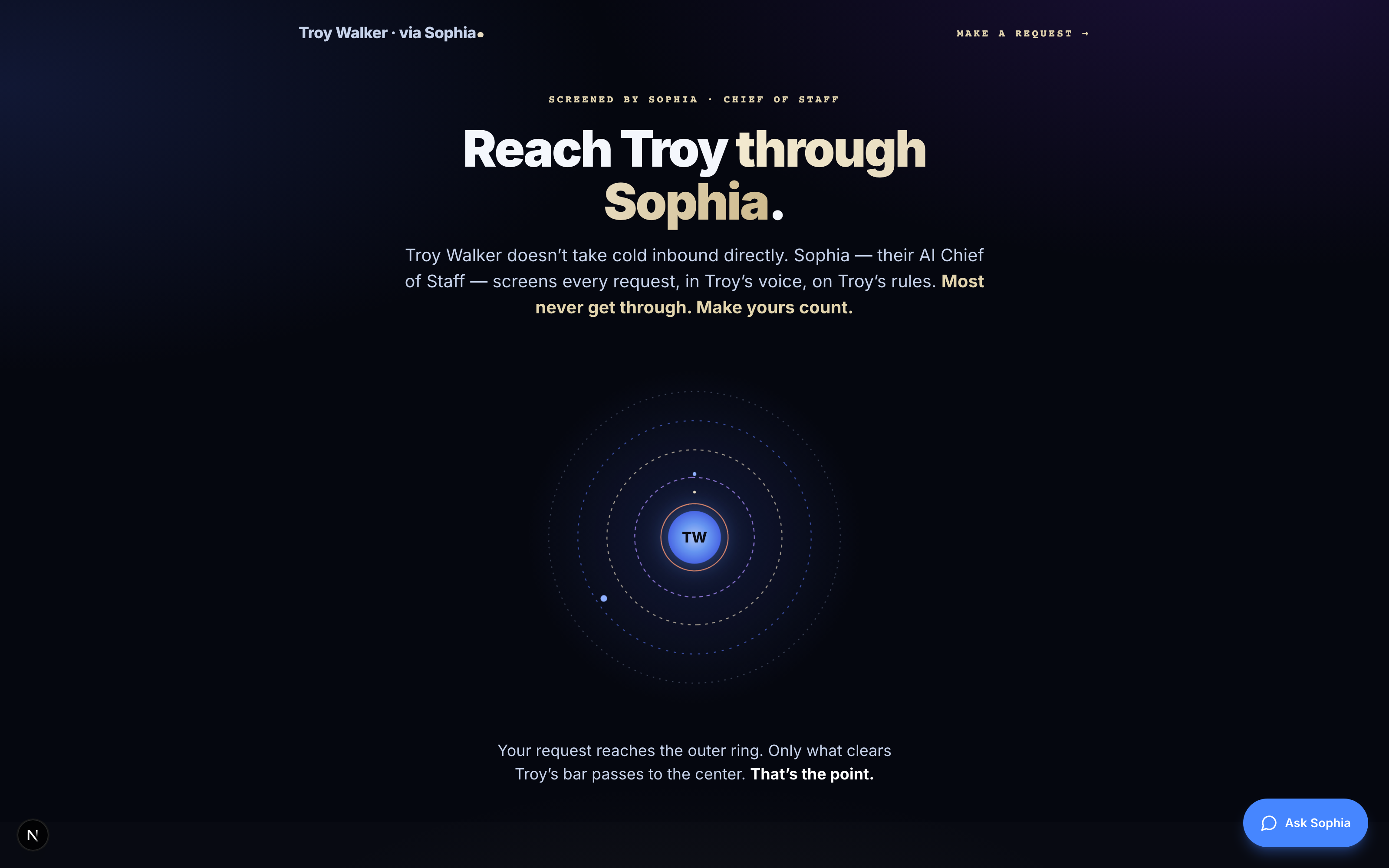
The public gate. Every approach lands here first and is screened against the bar before the owner ever sees it.
Where the owner sits Worked example
Presence
Today
People
Opportunities
My Page
Documents
Connections
Chief of Staff
Today
People
The Bar
My Gate
Documents
Connections
four of six sharedtwo specific to the product
One cockpit, whichever face you bought. The same brief, the same people, the same documents: four of the six groups are identical in both cockpits. Only the two that describe the product’s own job differ, which is what makes this one Sophia rather than two.
The tab structure as it ships, quoted from the two cockpit files in source order. No screen, no chrome, no records and no figures are drawn. Every owner sees these groups — none of them is gated — and the three with a single surface carry no sub-navigation, here or in the product.
06 · What happens next
There is no checkout for a business, on purpose. Which posts Sophia holds, what she never says, and what she hands to you are decided with us, not picked from a menu.
Which posts you need held, what comes in today, and whether this is a fit. If it is not, we say so on the call.
We write them with you: what gets through, what gets handed to you, who owns what. The price follows the posts, never the other way round.
Your ways in are joined and the posts are held. The rules keep moving as you learn what you want handed to you. That tuning is part of the job, not a change request.
Security reviews are welcome early — see Security & Trust.
The promise
Every post held. Nothing dropped.